

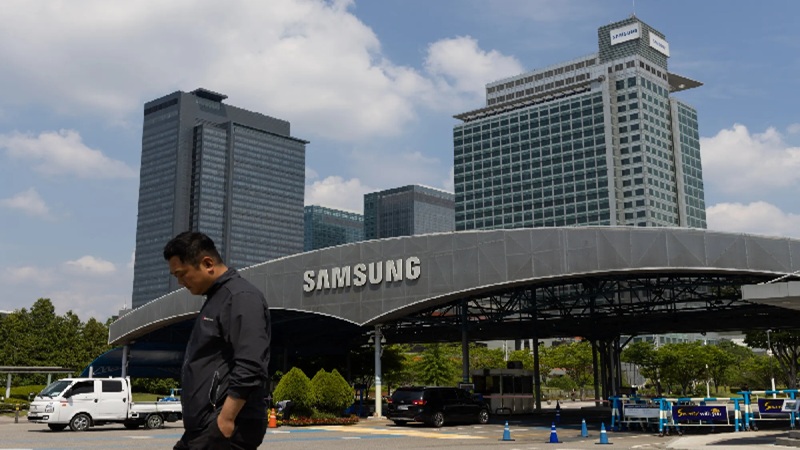
Samsung Electronics has surpassed the $1 trillion market capitalization milestone after its shares surged more than 15% in a single trading session, marking the largest one-day gain in the company’s history.
The rally positions Samsung as only the second Asian company to achieve the trillion-dollar valuation benchmark after TSMC, underscoring the growing investor appetite for companies at the center of the artificial intelligence infrastructure boom.
Record Earnings Fuel Investor Confidence
The sharp rise in Samsung’s valuation followed stronger-than-expected first-quarter results. The company reported operating profit of 57.2 trillion Korean won, more than eight times higher than the previous year, while revenue climbed to a record 133.9 trillion won.
Notably, the quarterly operating profit alone exceeded Samsung’s projected full-year 2025 operating profit estimate of 43.6 trillion won, reinforcing market optimism around the company’s semiconductor business.
AI Infrastructure Boom Drives Semiconductor Demand
At the core of Samsung’s momentum is surging demand for memory chips critical to AI computing.
The rapid expansion of generative AI systems has intensified demand for high-bandwidth memory (HBM), DRAM, and NAND chips—technologies essential for processing and storing the massive datasets required by AI models.
According to analysts, AI workloads are significantly more memory-intensive than traditional computing tasks, creating supply shortages across the semiconductor industry.
“These chips are crucial because AI systems require extremely high bandwidth and storage capacity,” said Yu Jing Jie.
Samsung’s Push Into High-Bandwidth Memory
Samsung is aggressively expanding its position in the HBM market, where it currently trails competitor SK Hynix.
SK Hynix controls roughly 55% of the global HBM market, while Samsung holds about 25%. However, Samsung recently announced mass production of HBM4 chips—the latest generation of high-bandwidth memory technology.
The chips are expected to play a central role in next-generation AI infrastructure, including future systems tied to NVIDIA’s upcoming Vera Rubin AI architecture.
Positive early customer feedback on Samsung’s HBM4 products has further strengthened investor sentiment.
Apple’s Manufacturing Talks Add Momentum
Investor enthusiasm was also fueled by reports that Apple has held discussions with Samsung and Intel regarding potential chip manufacturing partnerships in the United States.
While no formal agreement has been announced, the possibility of Samsung securing major production contracts from Apple has boosted confidence in the company’s long-term semiconductor prospects.
Broader Market Impact
Samsung’s rally also lifted South Korea’s broader equity market. Shares of SK Hynix climbed more than 10%, helping the Kospi index surpass the 7,000-point level for the first time in history.
The broader surge reflects how AI-related semiconductor companies are increasingly driving global market performance, as investors position themselves around the infrastructure powering the next wave of artificial intelligence.
Samsung’s trillion-dollar milestone highlights the growing strategic importance of semiconductor manufacturers in the AI era. As demand for advanced computing infrastructure accelerates, companies capable of producing high-performance memory and processing components are becoming central to the global technology ecosystem.
For Samsung, the challenge now shifts from reaching the milestone to sustaining momentum in a market where competition, innovation cycles, and geopolitical supply chain pressures continue to intensify.