


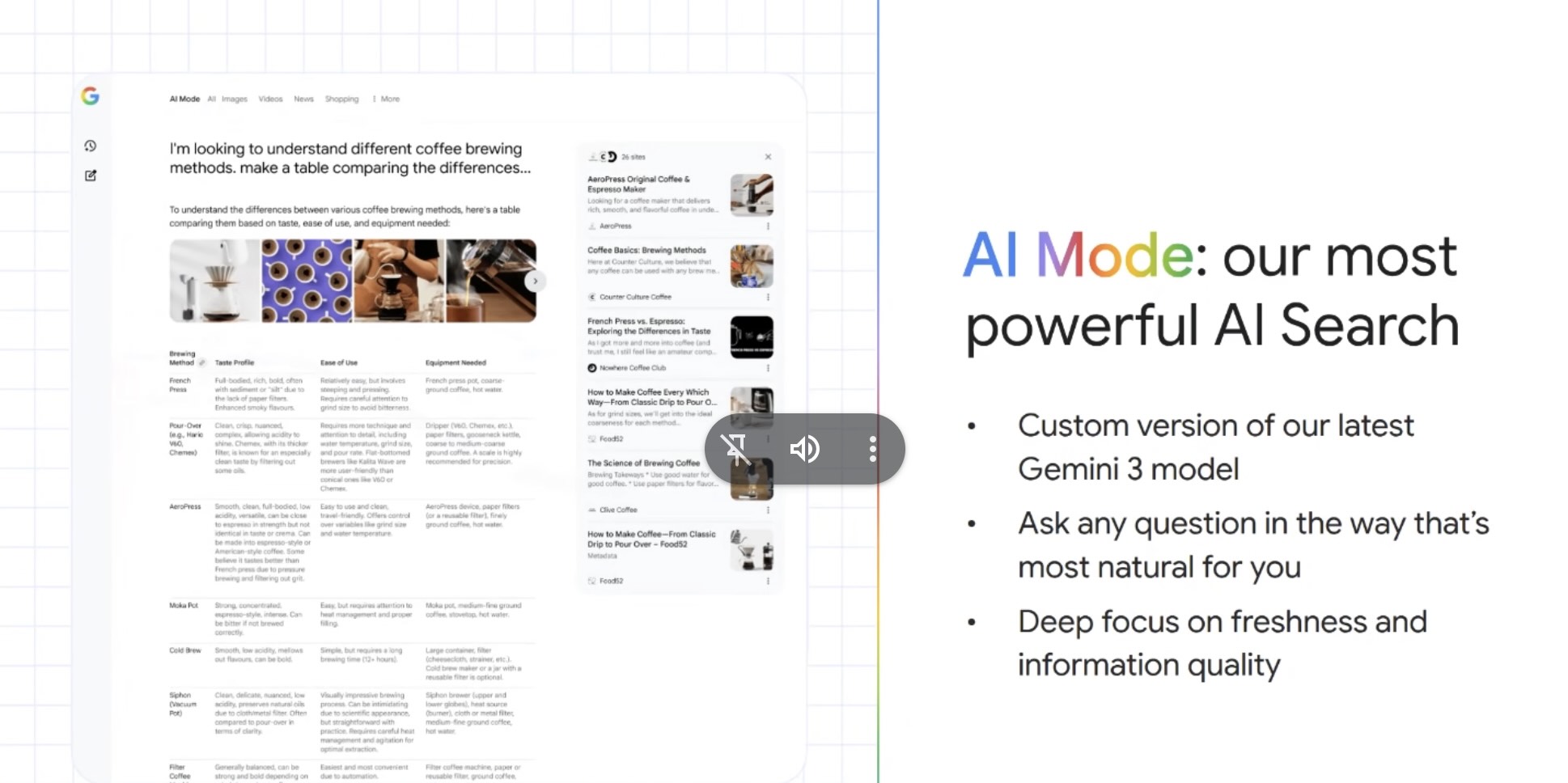
Google is accelerating its push into AI-powered search with the introduction of AI Mode, a new feature designed to make online discovery more conversational, interactive, and task-oriented.
The announcement was made during a press event led by Pandu Nayak, who outlined how advances in artificial intelligence are reshaping the company’s search infrastructure and user experience.
According to Nayak, Google is increasingly leveraging technologies such as transformers and Google Brain to improve language understanding, query interpretation, spam detection, and the overall relevance of search results.
AI Is Reshaping How Users Search
The latest evolution builds on Google’s broader AI search strategy, which already includes AI Overviews, a feature now used by more than 2 billion monthly users across over 200 countries and 40 languages.
AI Overviews generate concise AI-powered summaries alongside links to deeper sources, encouraging users to ask longer and more complex questions while still driving traffic to publishers and creators.
Google says the goal is not to replace the web, but to organize information more intelligently and help users navigate it more efficiently.
What Makes AI Mode Different
AI Mode combines real-time web data, the Knowledge Graph, and shopping information into a conversational interface that responds with synthesized answers instead of traditional lists of blue links.
One of its standout features is its side-by-side browsing experience on Chrome desktop. Users can open webpages alongside AI-generated responses, making it easier to compare information, explore related pages, and ask follow-up questions without losing context.
“With AI Mode in Chrome, you can easily explore related pages without breaking your flow,” Nayak explained during the presentation.
The feature also uses a “query fan-out” technique, where complex searches are broken into smaller sub-queries to deliver more comprehensive and nuanced responses.
Beyond Search: A More Personalized Internet Experience
Google’s broader AI search ecosystem extends beyond AI Mode itself.
Search Live
With Search Live, users can point their smartphone camera at objects and ask questions using voice prompts, receiving AI-generated responses in multiple languages. The feature reflects Google’s growing investment in multimodal AI interactions.
Personal Intelligence
Google is also introducing more personalized search experiences by tailoring results using contextual signals such as location, preferences, and previous activity.
For example, trip-planning searches may automatically account for family size, local currency, or destination-specific recommendations.
Agentic Search
Another new capability, Agentic Search, is designed to help users complete tasks directly from Search—including restaurant reservations and recommendation-based actions.
This marks a shift from Search as an information tool to Search as an execution platform.
AI Search Becomes A Competitive Battleground
Google’s latest rollout comes amid intensifying competition in AI-powered discovery, with rivals including OpenAI, Microsoft, and emerging AI startups rapidly integrating conversational interfaces into web navigation and productivity tools.
By embedding AI deeper into Chrome and Search, Google is signaling that the future of search will move beyond keyword retrieval toward real-time reasoning, contextual understanding, and multimodal assistance.
The launch of AI Mode underscores a larger transformation underway across the internet economy. Search engines are evolving from directories of information into intelligent assistants capable of interpreting intent, synthesizing knowledge, and helping users complete tasks.
For Google, the challenge will be balancing innovation with accuracy, safety, and publisher visibility as AI increasingly becomes the primary interface between users and the web.