

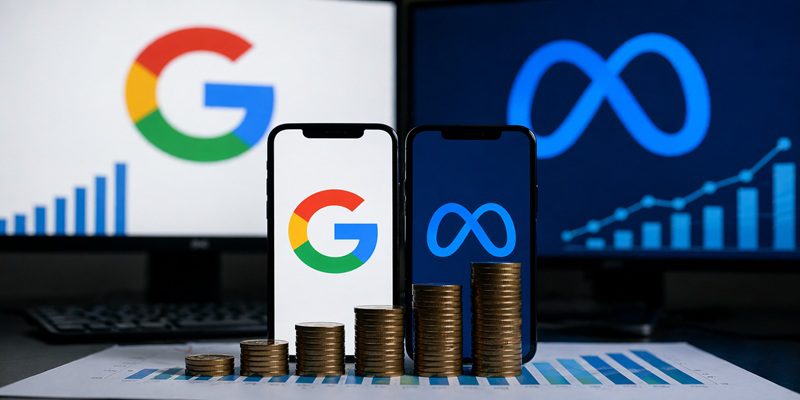
After more than a decade of dominance by Google, the global digital advertising hierarchy is on the verge of a major shake-up. Meta Platforms is projected to become the world’s largest advertising company by the end of 2026, marking a pivotal shift in the competitive landscape of online ads.
According to forecasts from Emarketer, Meta’s global net advertising revenue is expected to reach $243.5 billion in 2026, narrowly surpassing Google’s projected $239.5 billion. While the gap is modest, the underlying growth trends suggest a more decisive shift underway.
Meta’s ad business is expanding at a significantly faster pace, with growth projected at 24.1% in 2026, compared to Google’s steadier 11.9%. That divergence has been building over recent years, positioning Meta to edge ahead for the first time in the modern digital advertising era.
AI and Automation Drive Meta’s Momentum.
At the center of Meta’s surge is its Advantage+ advertising suite, an AI-driven platform designed to automate campaign creation, targeting, and optimization. By reducing the complexity of ad management, the tool has gained traction among businesses seeking efficiency and stronger returns on marketing spend.
This automation-first approach is proving particularly effective in a market increasingly shaped by artificial intelligence, where ease of use and performance optimization are becoming critical differentiators.
Beyond tooling, Meta has expanded aggressively across its ecosystem. Advertising integrations on platforms like WhatsApp and Threads have opened new monetization channels, while Instagram Reels continues to compete directly with short-form video rivals such as TikTok and YouTube Shorts, one of the fastest-growing segments in digital advertising.
Google’s Scale Meets Slower Growth.
While Google remains a formidable player, its broader business model presents a different dynamic. Advertising is just one part of its diversified revenue streams, which include cloud computing, hardware, and subscription services like YouTube Premium.
This diversification, while a strength, also means its ad business does not scale as rapidly as Meta’s more concentrated advertising model.
Still, Google’s influence remains substantial. Together with Meta and Amazon, the trio is expected to account for more than 62% of global digital ad spending in 2026, highlighting the increasing concentration of power among a few dominant platforms.
A Defining Moment for Digital Advertising.
If realized, Meta’s ascent would mark one of the most significant turning points in the history of digital advertising, ending Google’s long-standing leadership since the early days of search-driven marketing.
Looking ahead, the competitive balance will likely hinge on how both companies leverage artificial intelligence, expand their ad ecosystems, and deliver measurable value to advertisers.
In a market where performance, scale, and innovation dictate spend, the platform that best aligns these elements will ultimately define the next era of global advertising leadership.