


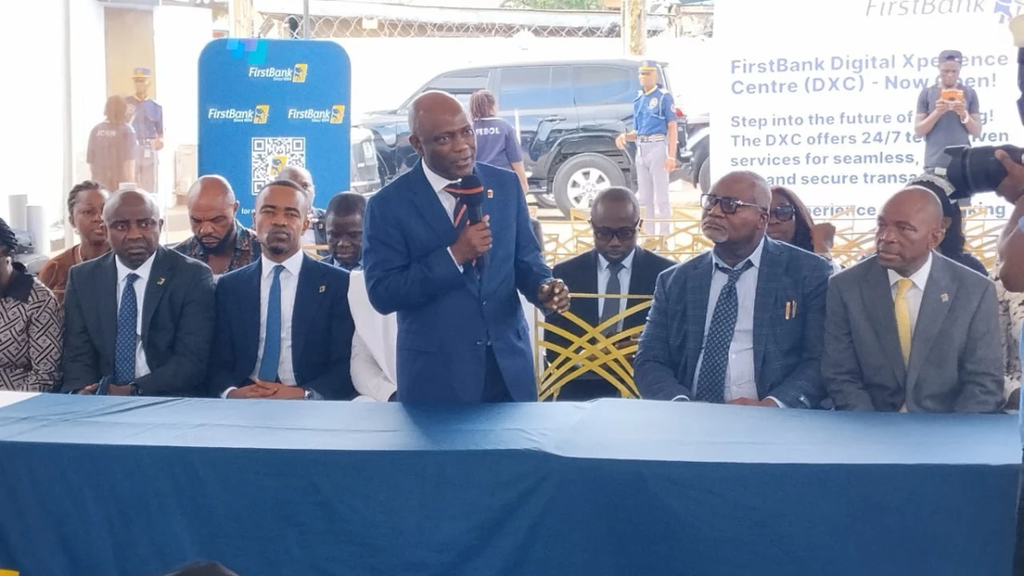
FirstBank of Nigeria has commissioned its 11th Digital Xperience Centre (DXC) in Festac Town, Lagos, expanding its network of automated banking facilities as the lender pushes to make more services available outside the traditional banking hall.
The new centre operates 24 hours a day and allows customers to carry out routine banking transactions independently, including cash deposits and withdrawals, fund transfers, account maintenance and ATM card issuance. FirstBank said it plans to expand the DXC network to more than 30 locations nationwide.
The Festac facility was commissioned on Tuesday, November 17, 2026, with FirstBank Chief Executive Officer Olusegun Alebiosu describing the centre as part of the bank’s effort to provide customers with round-the-clock access to banking services.
A bank branch that does not depend on banking hours
The expansion reflects a broader shift in how traditional banks are delivering routine services. Instead of requiring customers to visit a conventional branch and wait for an employee to process a transaction, FirstBank’s DXCs are designed around self-service and automation.
At the Festac centre, customers can obtain new ATM cards, deposit and withdraw cash, transfer funds and update account information without interacting directly with bank employees.
Customers can also update details such as their phone numbers, National Identification Number (NIN) and Bank Verification Number (BVN), while the facility provides options for blocking ATM cards and restricting transactions where unauthorised access is suspected. Other services across FirstBank’s DXC network include balance enquiries, statement requests, bill payments, cheque management, fixed-deposit booking and complaint logging.
FirstBank introduced its first DXC in Victoria Island, Lagos, in 2021 as a fully automated banking facility. The bank describes the model as a self-service branch designed to combine automated machines with technologies such as video banking, biometric authentication and one-time passwords.
Why the Festac location matters
For FirstBank, the location of the latest centre is as important as the technology behind it.
Alebiosu said Festac was selected because of its large population, commercial activity and improved security. The centre also addresses a practical problem for businesses and individuals who handle cash outside conventional banking hours.
Customers who close their businesses late, for example, can deposit their day’s takings immediately instead of carrying substantial amounts of cash home and waiting until the following morning to visit a branch.
The cash-deposit function therefore positions the DXC as more than an alternative to the ATM. For small businesses and cash-intensive merchants, it can serve as an after-hours banking point.
The facility also allows customers without an ATM card to obtain one and use it immediately for cash withdrawals, according to Alebiosu.
FirstBank targets more than 30 centres.
The Festac facility brings FirstBank’s DXC network to 11 locations, with the bank targeting more than 30 centres across Nigeria.
Existing locations include Adetokunbo Ademola in Victoria Island, Banana Island and Admiralty Way in Lagos, alongside centres in Abuja, Ibadan, Nsukka, Kano, Benin City and the University of Abuja.
The planned expansion would significantly increase the number of locations where customers can access banking services beyond conventional branch operating hours.
The strategy also fits into FirstBank’s longer-term digital transformation programme. The bank has previously described its DXCs as an attempt to reinvent the conventional branch by combining self-service technology, automated cash handling, digital account services and remote interaction with bank staff.
Automation is changing the banking experience
The expansion comes as Nigerian banks increasingly invest in digital channels, automated service points and technologies designed to reduce customers’ dependence on physical banking halls.
For FirstBank, the DXC model does not completely eliminate conventional branches. Instead, it shifts routine transactions away from staff-assisted banking while leaving more complex services and customers who prefer face-to-face interaction within the traditional branch network.
At the Festac commissioning, FirstBank Executive Director, Enterprise Transformation and Digital Directorate, Dr Julius B. Omodayo-Owotuga, said the transformation programme was intended to make banking services more seamless while recognising that some customers would continue to prefer human interaction.
The bank is also considering further automation. Omodayo-Owotuga mentioned a possible drone-based cash delivery service that could allow customers to request cash through their phones and have it delivered to their homes. No implementation timeline or operational details were provided, making the proposal an indication of the direction FirstBank is exploring rather than an active service.
The employment question
The growing use of automation also raises a question that extends beyond customer convenience: what happens to banking jobs as more routine transactions become machine-driven?
A customer at the commissioning raised concerns about the potential effect of technology on employment, particularly for young Nigerians and university graduates.
Alebiosu rejected the idea that automation should necessarily translate into job losses, arguing that technology could create new employment opportunities while changing the skills required within the workforce. He also encouraged young Nigerians to combine formal education with practical, vocational and entrepreneurial skills.
The issue is likely to remain relevant as banks continue moving routine transactions away from traditional counters. The expansion of FirstBank’s DXCs suggests that the future of physical banking may increasingly involve fewer routine transactions being handled by employees, with technology taking responsibility for basic services while human staff focus on more specialised customer and business needs.
For FirstBank, the immediate objective is clear: make banking available beyond the limits of conventional branch hours. With 11 DXCs now operating and more than 30 planned, the bank is betting that convenience, automation and round-the-clock access will become an increasingly important part of the Nigerian banking experience.