

In Nigeria’s crowded quick-service restaurant industry, growth is often associated with deep-pocketed investors, celebrity endorsements, or multinational backing. Yet one of the country’s most remarkable food business success stories began far from the commercial districts of Lagos or Abuja.
Item7Go started as a modest food stall serving students around the University of Ilorin. Today, it has grown into a recognisable restaurant brand with a presence across multiple Nigerian cities, attracting thousands of customers daily and competing in an industry dominated by long-established players.
Its journey offers more than an inspiring entrepreneurial story. It provides a practical blueprint for how African businesses can scale from a single location into a nationally recognised brand through operational discipline, customer obsession, and strategic expansion.
This is the first edition of Business Inside Gist, where Business Verge takes readers inside the growth engines of Africa’s most interesting companies.
The Beginning: Solving a Simple Problem
When founder Ibigbemi Oloruntobi launched what would eventually become Item7Go in 2012, his goal was not to build a national restaurant chain. The immediate opportunity was providing students around the University of Ilorin affordable meals that were filling, consistently available, and served quickly enough to fit into demanding academic schedules.
Rather than creating a sophisticated dining experience, the business focused on solving three practical problems:
- Food affordability
- Portion size
- Speed of service
This early focus soon became the foundation of the company’s growth strategy.
Many businesses fail because they attempt to solve too many problems at once. Item7Go succeeded because it became exceptionally good at solving one.
The Power of Starting Small
One of the most overlooked aspects of Item7Go’s journey is what it did not do.
The company did not rush into Lagos immediately; it did not pursue aggressive nationwide expansion, nor did it attempt to become everything to everyone.
Instead, it concentrated on dominating its immediate environment.
By serving students repeatedly and gathering constant feedback, the company refined its menu, pricing model, operational systems, and customer experience before attempting wider expansion.
This allowed Item7Go to develop something every scalable business needs: a repeatable operating model.
Why Customers Kept Coming Back
Many restaurant businesses attract customers at once and often struggle with getting them to return. Item7Go built its reputation around four factors that encouraged repeat patronage.
Consistency
Customers knew what to expect every time they placed an order. In an industry where service quality often fluctuates, consistency became a competitive advantage.
Affordability
Even during periods of inflation and rising food costs, the brand remained strongly associated with value for money.
Speed
The quick-service model reduced waiting times and increased customer throughput.
Familiarity
Rather than introducing complicated menu concepts, Item7Go focused on meals Nigerians already loved and consumed regularly, like Nigerian smoky party jollof. The result of this was a product offering that appealed to a broad consumer base.
Scaling Without Losing Identity
The transition from a local food outlet to a multi-city restaurant chain is where many businesses struggle as expansion usually introduces new challenges:
- Supply chain complexity
- Staff management
- Quality control
- Brand consistency
Item7Go’s growth suggests that the management understood an important principle: Growth should follow systems, not precede them.
By the time the company entered larger markets such as Lagos, it had already spent years refining operational processes. This reduced the risk of rapid expansion undermining customer experience.
The Lagos Test
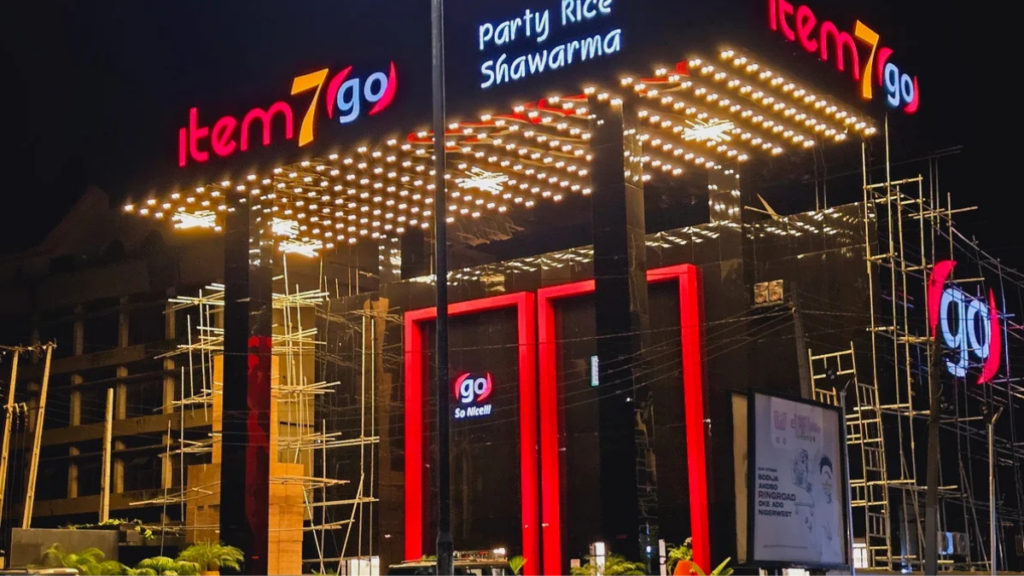
Every Nigerian consumer brand eventually faces a defining question: can it succeed in Lagos? For Item7Go, expansion into Lagos represented more than geographical growth. It was a test of whether a business model developed in Ilorin could compete in one of Africa’s most competitive consumer markets.
The answer, however, appears to be yes. The company’s growing visibility in Lagos helped transform it from a regional success story into a nationally recognised brand.
More importantly, it demonstrated that businesses built outside Nigeria’s major commercial centres can successfully compete on a national stage.