

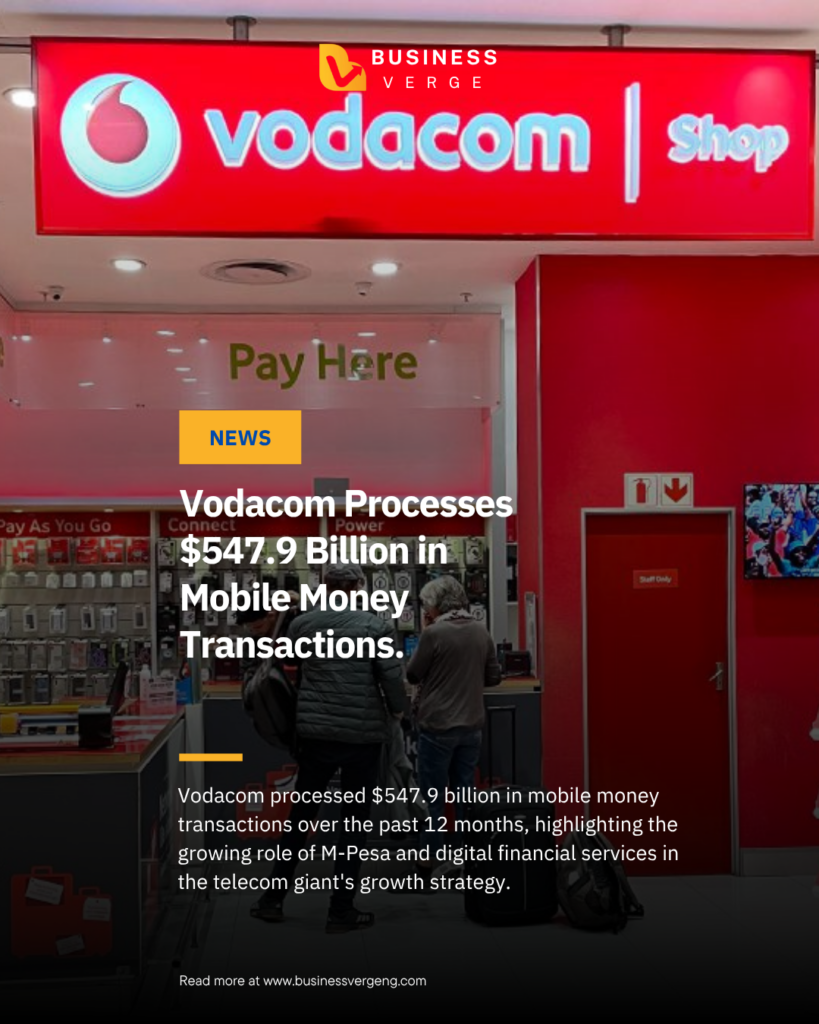
Vodacom Group processed $547.9 billion in mobile money transactions over the 12 months ending June 2026, underscoring the rapid evolution of Africa’s telecom operators into major financial services providers.
The milestone, disclosed in the company’s latest quarterly trading update, reflects the growing importance of M-Pesa and other digital financial services as key revenue drivers alongside traditional voice and data services.
With operations spanning Tanzania, Mozambique, Lesotho, the Democratic Republic of Congo (DRC), Ethiopia, and Egypt, as well as its strategic stake in Safaricom, Vodacom continues to strengthen its position in Africa’s expanding digital payments ecosystem.
Mobile money becomes a core growth engine
The transaction value highlights the scale at which mobile money has become embedded in everyday life across Africa.
For millions of users, mobile phones now serve as digital wallets for sending money, paying bills, receiving salaries, purchasing goods, and accessing financial services—often without the need for a traditional bank account.
Vodacom reported continued growth in financial services revenue during the quarter, driven by increased M-Pesa adoption across its operating markets.
The company’s financial services expansion has gained additional momentum following the consolidation of Safaricom, whose M-Pesa platform remains the most mature and widely adopted mobile money ecosystem on the continent.
Beyond voice: Data and fintech reshape revenue
Like many telecom operators across Africa, Vodacom is experiencing a shift in consumer behaviour.
Traditional voice revenue is gradually giving way to higher demand for mobile data and digital financial services as smartphone adoption continues to rise.
Consumers increasingly rely on mobile internet for communication, entertainment, online shopping, digital banking, and business activities, driving sustained growth in data usage.
At the same time, mobile money has evolved from a value-added service into a strategic business segment that generates recurring transaction-based revenue.
The combination of connectivity and financial services is helping diversify Vodacom’s earnings while strengthening customer engagement across its markets.
Enterprise services also contribute to growth
Beyond consumer services, Vodacom continues expanding its enterprise business by providing connectivity, cloud services, cybersecurity solutions, and digital platforms to businesses across Africa.
Enterprise services have become an increasingly important revenue stream, offering predictable long-term income while supporting businesses undergoing digital transformation.
This diversification strategy allows Vodacom to reduce dependence on traditional telecom revenues while positioning itself as a broader technology and digital infrastructure provider.
Safaricom strengthens Vodacom’s fintech ambitions
Vodacom’s strategic relationship with Safaricom remains central to its long-term financial services ambitions.
Kenya’s M-Pesa ecosystem is widely regarded as one of the world’s most successful mobile money platforms, supporting millions of daily transactions ranging from merchant payments and salary disbursements to remittances and savings.
By integrating Safaricom more closely into its operations, Vodacom gains deeper exposure to one of Africa’s most advanced digital financial ecosystems while leveraging best practices across its other markets.
What it means for Africa’s digital economy
The $547.9 billion processed through Vodacom’s mobile money platforms demonstrates how telecom operators are increasingly becoming critical players in Africa’s financial ecosystem.
As smartphone adoption, internet penetration, and digital payments continue to expand, telecom companies are no longer simply providing connectivity they are enabling financial inclusion, supporting commerce, and delivering digital services to millions of underserved consumers.
For Vodacom, the growing contribution of M-Pesa signals a broader transformation from a traditional telecommunications company into a diversified digital services and financial technology business, positioning the group for continued growth as Africa’s digital economy evolves.