

When MTN Nigeria rebranded its fibre broadband service as MTN FibreX in April 2025, the strategy was simple: expand reliable high-speed internet access to more homes and businesses while strengthening its position in Nigeria’s rapidly evolving broadband market.Less than a year later, the results suggest the bet is paying off.
FibreX subscribers climbed from 11,794 in January 2025 to 89,441 in January 2026, representing a remarkable 658% year-on-year increase. The growth signals rising demand for fixed broadband services in a country where mobile networks have long dominated internet access.
For Egerton Idehen, Chief Broadband Officer at MTN Nigeria, the surge reflects a shift in how Nigerians are consuming digital services. High-bandwidth activities such as remote work, gaming, streaming and content creation are pushing users toward more stable connections that mobile networks alone cannot always deliver.
In an interview with Technext, Idehen explained that while wireless technologies remain central to Nigeria’s connectivity future, fibre infrastructure plays an equally important role in enabling high-capacity digital experiences.
“Wireless will take Nigeria into the future, but fibre ensures that future is fast, stable and limitless,” he said, adding that the company plans to expand FibreX coverage to more estates, communities and cities nationwide.
The broader industry outlook supports this strategy. According to projections from the Nigerian Communications Commission Spectrum Roadmap for 2026 to 2030, 5G coverage in Nigeria could expand from roughly 13% today to around 50% by the end of the decade. At the same time, the country’s internet user base is expected to approach 200 million.
As mobile networks grow, fibre backhaul and home broadband infrastructure will be essential to support higher data consumption. MTN positions FibreX as part of that complementary ecosystem, offering speeds of up to 1 Gbps for households and businesses with intensive data needs.
One factor driving the service’s appeal is its unlimited data model. Many internet providers in Nigeria impose a Fair Usage Policy that slows speeds after users consume a certain volume of data. FibreX plans, however, are designed without data caps or throttling, allowing customers to stream, download and work online without worrying about limits.
Pricing also plays a role. FibreX packages begin at about ₦25,000 per month for speeds of 50 Mbps, positioning the service between mobile broadband and satellite internet in terms of affordability. By comparison, satellite provider Starlink charges roughly ₦150,000 per month for its priority plan in Nigeria, in addition to hardware costs that can reach ₦2.4 million.
The combination of speed, unlimited data and comparatively lower pricing appears to be attracting Nigeria’s growing middle-class internet users who require more reliable connectivity than mobile data plans typically provide.Subscriber growth illustrates this trend. Between April 2025, when the service was rebranded, and January 2026, FibreX added nearly 63,000 new users an increase of more than 421%. Adoption peaked in September 2025 when the service recorded its highest monthly growth since launch, with subscribers rising by 56.8% in a single month.
Despite the rapid growth, expanding fibre infrastructure across Nigeria remains complex. MTN’s long-term plan aims to connect more than eight million homes by 2028, but achieving that scale will require extensive infrastructure rollout across cities and communities.
The company says its short-term strategy includes expanding into new neighbourhoods, increasing network depth in existing FibreX locations and reducing activation times for new customers. Over the long term, the focus is on supporting Nigeria’s national broadband expansion and strengthening the country’s fibre backbone.Federal initiatives are already moving in that direction. Under Project Bridge, the Nigerian government aims to expand national fibre capacity from roughly 35,000 kilometres to 125,000 kilometres by laying an additional 90,000 kilometres of fibre optic cable across the country.
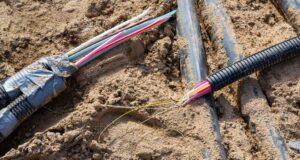
For telecom operators, however, infrastructure expansion comes with persistent challenges. MTN reported more than 9,200 fibre cuts in 2025 and about 211 cases of site vandalism, disruptions that can cause service outages and increase operational costs.
Idehen argues that stronger policy support is necessary to address these issues. While telecom infrastructure has already been classified as Critical National Information Infrastructure (CNII), enforcement and protection measures remain uneven.
He also called for a unified and affordable right-of-way policy across Nigerian states, which would significantly reduce the cost and complexity of deploying fibre networks.Without such reforms, telecom operators face delays when accessing communities, installing ducts or negotiating with local authorities. In some estates, companies also encounter requests for community support initiatives before installation can proceed.
Even so, MTN believes collaboration with local governments, security agencies and communities will remain central to protecting telecom assets and ensuring reliable connectivity.
The company’s financial performance underscores how critical broadband has become to its business. In its 2025 year-end earnings report, MTN Nigeria recorded a 74.5% year-on-year increase in data revenue, which climbed to ₦2.8 trillion. Active data users grew to 53.2 million, while overall data traffic rose 34%.
As digital services continue to expand across Africa’s largest economy, the rapid growth of FibreX suggests Nigeria’s broadband future will likely depend on a hybrid model where wireless connectivity expands reach and fibre infrastructure delivers the speed and stability powering the country’s next phase of digital transformation.